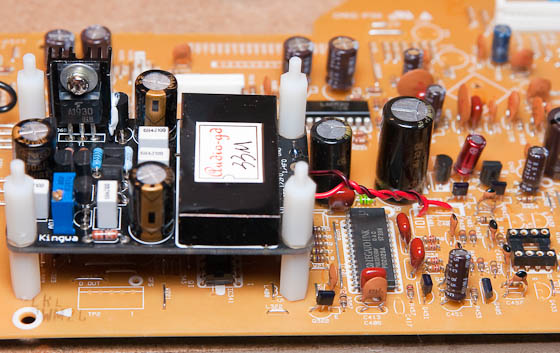
Here is the second part of how to improve the quality of an old CD player, the Pioneer PD S-505. You can find the first part here. In this section, I’m going to show you how to install a better, more stable clock circuit into your 505 to lower the jitter. This particular clock comes from Kingwa, that has a series of crystal oscillators for improving DVD players, CD players, and DACs. The price is reasonable. I’ve installed them in three different units and had zero problems, so the quality seems reasonable.
Ok, so why install a new clock? Isn’t there one in there already? Yes, your right. But by using better parts like crystals with lower ppm and also design a very clean power supply to feed the clock, you can make your CD-player sound much better. And the reason is lower jitter.
But what is jitter? There is plenty of excellent places to go read up on it. Here’s some.
http://www.audiocraftersguild.com/AandE/cd-jitter.pdf (PDF warning)
http://www.stereophile.com/reference/590jitter/
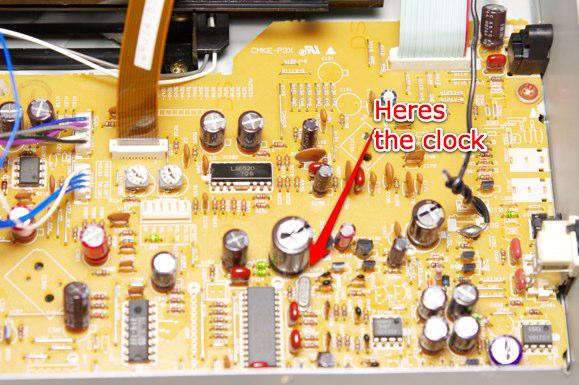
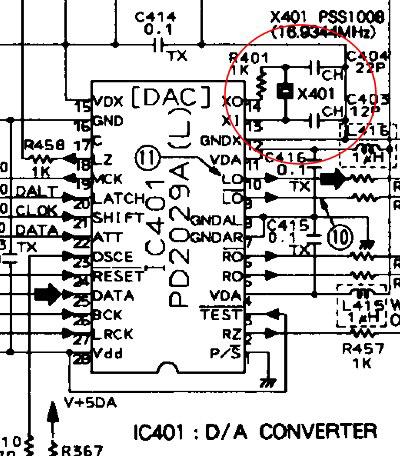
Ok, let’s look at the schematic. Here you can see the clock and two capacitors, C404 and C403 and the clock is X401. The clock is feeding into the DAC (PD2029A) (you can find the complete schematic in part one)
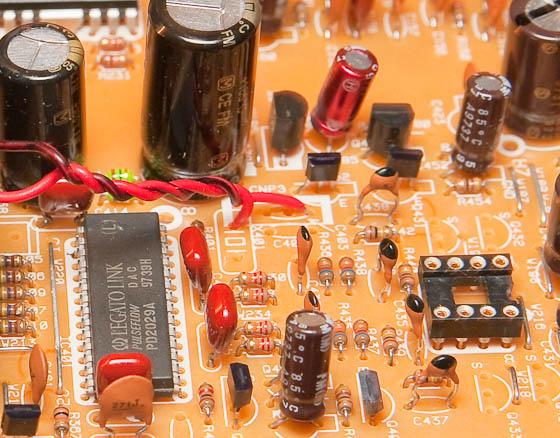
We need to remove the crystal X401, and the two capacitors, C403 and C404. The old load capacitors are no longer required. The next step is to connect the Kingwa clock to the DAC. As seen in the schematic, the clock is 16.9344Mhz, so we need to use the right outlet from the Kingwa clock. There are three different divisions of the clock. You need to solder two connections. One is for the ground, labeled GND, and the one next to it marked 1/4F0.
Now we need to feed the signal generated from the new clock to the DAC. Connect one of them to the hole in C403 furthest away from the DAC. I put the GND line here. The other one should go where the old clock used to go. Use the one closest to the large capacitor for the DAC (see picture).
The Kingwa clock is going to need power. Any voltage between 10-30 V DC will do. I will have an upcoming article about the power supply I built for it. You will find the connectors for the power on the top side of the Kingwa clock.
Next step, testing. Put in a cd. If you have the cover removed when doing the testing, REMEMBER THAT YOU ARE EXPOSED TO DANGEROUS HIGH VOLTAGE! No touchy while doing this. Not on the part we soldered but on the power supply. Anyway, If you didn’t know this, you really should not be doing this in the first place.
When you press power, it should read the TOC from the CD. Press play. If the display shows the seconds ticking, you can turn the player off, unplug and put the cover back on.
Hi there.. Im following your mods. Im very interested. Did the sound change anything? Im interested in a better power supply. Hope to get response from u soon. Marry Cristmas
I'm working on the redesign of the power supply. Need to move some stuff around for better cooling. This was more of an exercise in improving measurable parameters https://www.jackenhack.com/measurement/pioneer-pd-s505-vs-mod-3/ but I think it sounds much nicer now. And it should.
Hi....just bought a brand new pd-s505 in a small town in Mexico, it came in its original package and plastics. Pioneer even gives a 1 year garranty. The same store still has a pd-s904.....also brand new. I connected my pd-s505 to a new Yamaha S-300 and am very satisfied with the combination. I chose the pd-s505 over a new cdc600 from Yamaha.......I do not know why......the Pioneer just impressed me.......
hello, thank you for posting this, i think ill put too kingwa clock in my sony 791, greetings from poland
Hello! I follow youre inprovement of the S505 with great intresst. I just descover it in the net. I'm a recording engineer myself for 40 years. I accidetely buy a 505, 10 years ago and I found that it had a great sound. and still have! When you have a update for the power supply, let me know. Then I start to do all youre updates, because they make a lot of sence.( and I can solder ) Did you end up with the LM 4562? Please let me know about it all. I got recently a present from and old friend. It's a Quad 77 stack... It sound great, but the CD player is a disaster.. It won't track and all that stuff.. I think I know the reason, it's all about the sledge shaft and the grease, but I do have the stuff to fix it .When I get it fixt, how would that player, in your opinion, be compere to the 505? Sorry about poor english, but I am from Norway, that should explain all... Look forward for your answer. Best Rolf Kjernet
Hi, doesnt the Kingwa Clock need to be connected to 1/2FO and nor 1/4FO like you said so? 1/2 of 33 is 16...? Greetings
Sorry, it depends on which clock you put in...
Hello Could you tell how you powered the kingwa clock and what power source you put in Thank you